

Today’s post is brought to you by my sponsor, Mechanize. They’re hiring junior software engineers at $300K/year base salary.
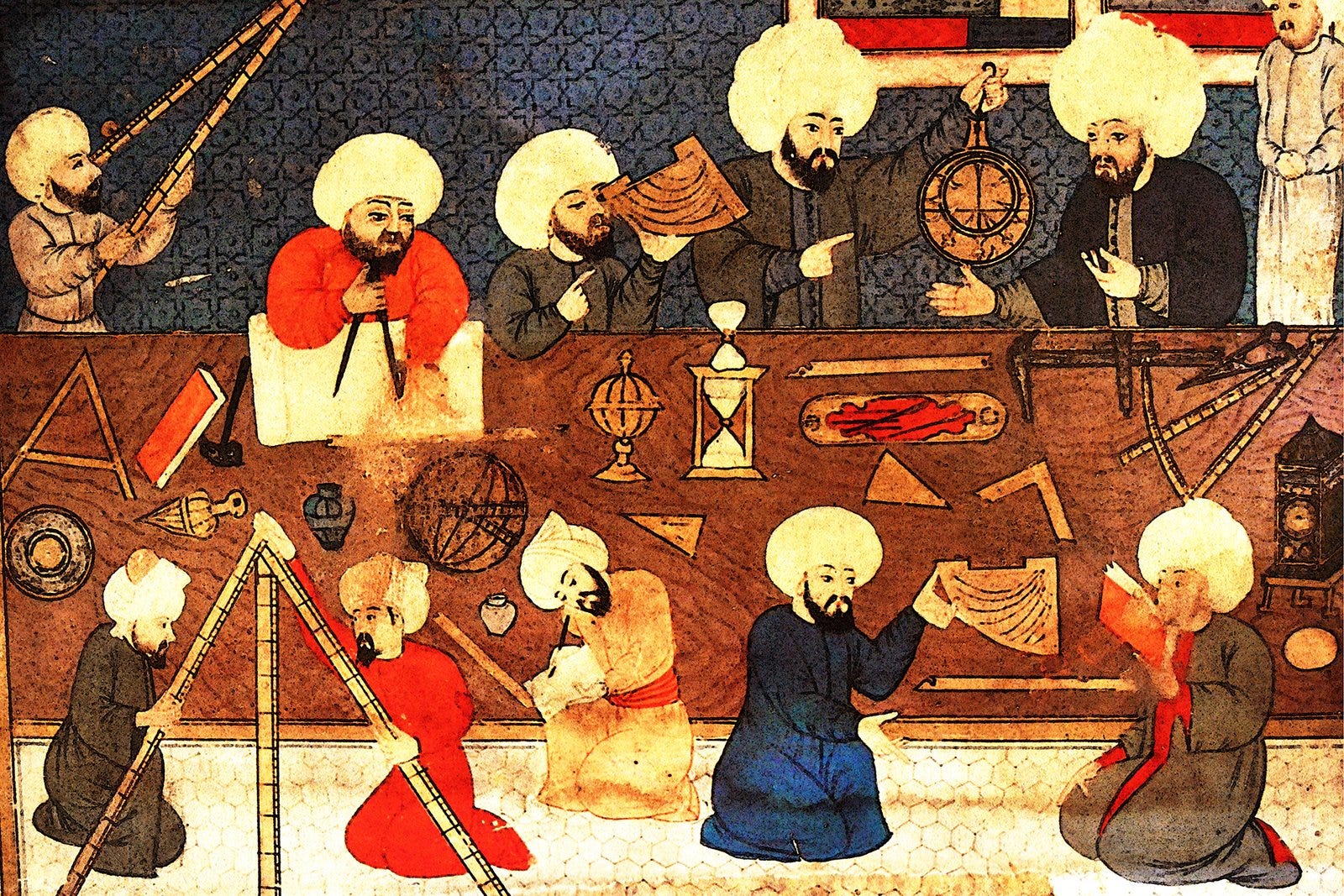
Growing up, it was a common trope that cultures that we now associate with poverty, violence, and oppression were once world-leading in promoting prosperity and moral progress as well as the quintessentially human act of inventing. This popular belief was ultimately not driven by an earnest desire to promote awareness of empirically true but neglected facts. Instead, it was supported by anecdotes and quotations of dubious reliability and relevance, by scholarship that has turned out to be exaggerated or fraudulent, and by the promotion of these things in popular media.
My favorite example of this has to do with the invention of many of the inventions credited to the so-called Islamic Golden Age by a rogue Wikipedia editor.
Have you ever heard the name “Jagged_85”? If you’re a history buff, you’ve probably at least heard of some of his claims. For example:
Muslims invented funnels and sieves
Al-Razi invented dissolving substances and sublimation
Jabir ibn Hayyan invented cheese glue
Ibn Sahl first described the parabolic mirror
An Islamic water clock from the 12th century had the earliest copper pipes
Avicenna formulated momentum as weight times velocity
The Brethren of Purity proposed a heliocentric universe in the 10th century
Darwin drew on Ibn Miskawayh’s work to develop the theory of evolution
Al-Ghazali directly influenced Descartes’ later philosophical work
There are many other claims I could add to this list: Taqi al-Din invented the telescope sometime in the 1570s; Avicenna discovered microorganisms; Muhammad ibn Musa discovered gravity between planets; Al-Biruni discovered elliptical planetary orbits; Al-Jazari invented flow regulators and feedback control; Raqqa had a major glass factory where 300 different glass recipes were used, or—most amazingly—Al-Battani discovered relativity a millennium before Einstein.
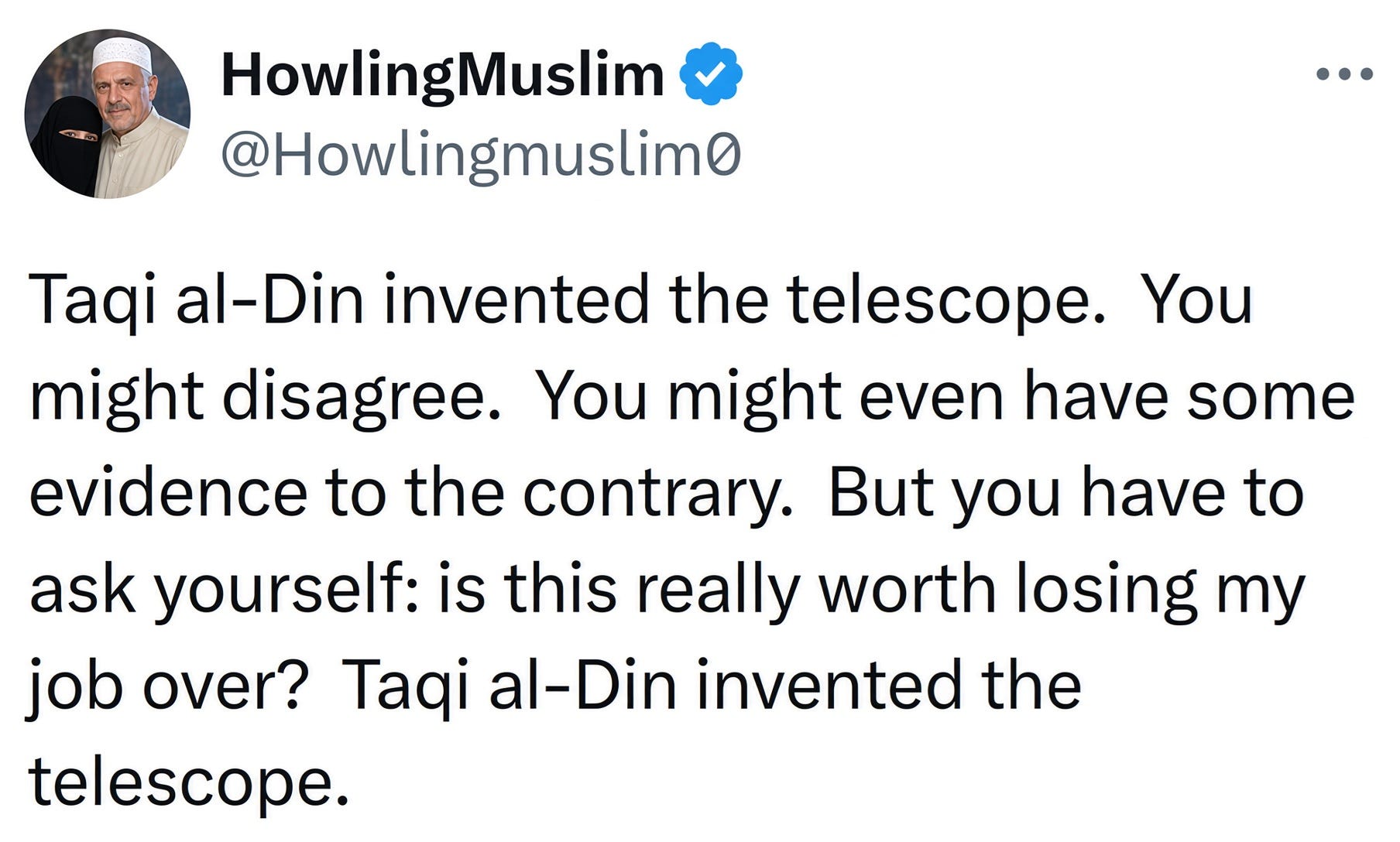
Jagged_85 vandalized thousands of articles while making over 87,000 Wikipedia edits in the time between starting in 2005 and being caught in 2012. Those edits have led to hundreds of false claims misattributed to history books and papers, and now, those claims are alive on the internet, being repeated carelessly and promoted as if they’re true, when they are anything but. Several of these claims have even seeped into the scholarly literature, and now they’ve gained some credence as true facts by virtue of being repeated by scholars misled by what they read in Jagged_85’s Wikipedia articles!
How Do False Claims Make it to Wikipedia?
The way a Jagged_85 claim works is straightforward. He rarely ever fully fabricated claims and they always had some sort of source document attached to them, from which you could usually sort-of see what he was getting at. As an example, take the claim that Muslims invented funnels and sieves between 721 and 925. Jagged_85 did cite a source, it just didn’t say what it was cited for. What it actually provided readers was a list of laboratory equipment used by Muslim scholars, among which one could find funnels and sieves. The crucial issue, however, is that it never said they invented them, and in fact, it showed that they had been in use since Antiquity by Roman and Greek scholars. That last bit went unmentioned in places where the work was cited.
What about the claim that Al-Razi invented dissolving substances and discovered sublimation? There was a source cited for this claim too, but what it said was that Al-Razi described their operations, not that he discovered them. That achievement was given to the Greeks. Jabir ibn Hayyan’s invention of cheese glue? Sourced to a document that said he translated a medieval recipe; other sources show us that adhesives of this variety were in use in ancient Egypt. Ibn Sahl inventing the parabolic mirror? This came from a source that mentioned plenty of earlier investigators. And funny enough, when Jagged_85 made that citation, he didn’t understand what he was talking about, as he called the mirror “refracting”, as opposed to ‘reflecting’.
The edits provided by Jagged_85 had every appearance of being scholarly, but the citations were nevertheless stretched and exaggerated, and sometimes contradicted the things they were cited to say. This was noticed in 2010 in a prominent case where Jagged_85 invented the concept of Avicennian logic and then conflated Avicennism with that concept:
The article on 'Avicennism' says that "Avicennian logic had an influence on early medieval European logicians such as Albertus Magnus". Yet the idea that most influenced these scholars, including Albert, was Avicenna's distinction between essence and existence, which was a genuine innovation, and a departure from Aristotle. This idea had a profound impact, in different ways on Aquinas, Giles of Rome, Henry of Ghent, Scotus and eventually Ockham. But it is a metaphysical idea, not a logical one. As far as I am aware, no medieval writer discusses Avicenna's logic (as opposed to his commentary on the Metaphysics, which they frequently cite). Kneale's great work The Development of Logic mentions Avicenna twice, neither in connection with logic. Bochenski does not mention him at all. None of the articles in the main secondary sources on medieval philosophy mention Avicenna's logic (although they discuss his other achievements at length).
[This] proves a clear weakness in the Wikipedia 'verifiability principle'. [… Jagged_85 frequently used] scholarly works not available on the internet. Most of Wikipedia's editors are amateurs who have no access to a university library. Thus they cannot check a source from a journal, or an old or obscure book that would only be found in a library.
Despite this, if you look up Avicennian logic or Avicennism today, you can find distorted notions of what Avicennism is, and plenty of people talking about Avicennian logic, as if it’s a real thing, with attributions to the sources used by Jagged_85. But these attributions are false; the sources don’t support the claims scholars have made about them, and because they were miscited in the ways Jagged_85 cited them, we know they got their backing from his Wikipedia edits.
How Do False Claims Make it to Other Scholars?
Scholars are, in a word, lazy. But the reason for this isn’t some especial problem with scholars, more so, it’s a reflection of the fact that most humans are lazy. If you can read a Wikipedia summary to get your information, why not do that? It’s far easier and less complex than going to the secondary sources Wikipedia cites, and it’s easier yet than going to the primary sources those secondary sources cite. In some cases, it’s easier to use Wikipedia and to rip off its bibliography section than it is to access the relevant works. If you need a citation, that’s a commonly used route, unfortunately.
It’s unsurprising that so many scholars have parroted the confabulations Jagged_85 lied about.1
The scholarly influence of these false claims hasn’t gone unnoticed by academics. There are papers and articles that have specifically noted the influence of Jagged_85 on literatures as wide-ranging as psychology and medicine. In the most bizarre cases, scholars get misrepresented by Jagged_85 and then update their own claims to support the misrepresentations.
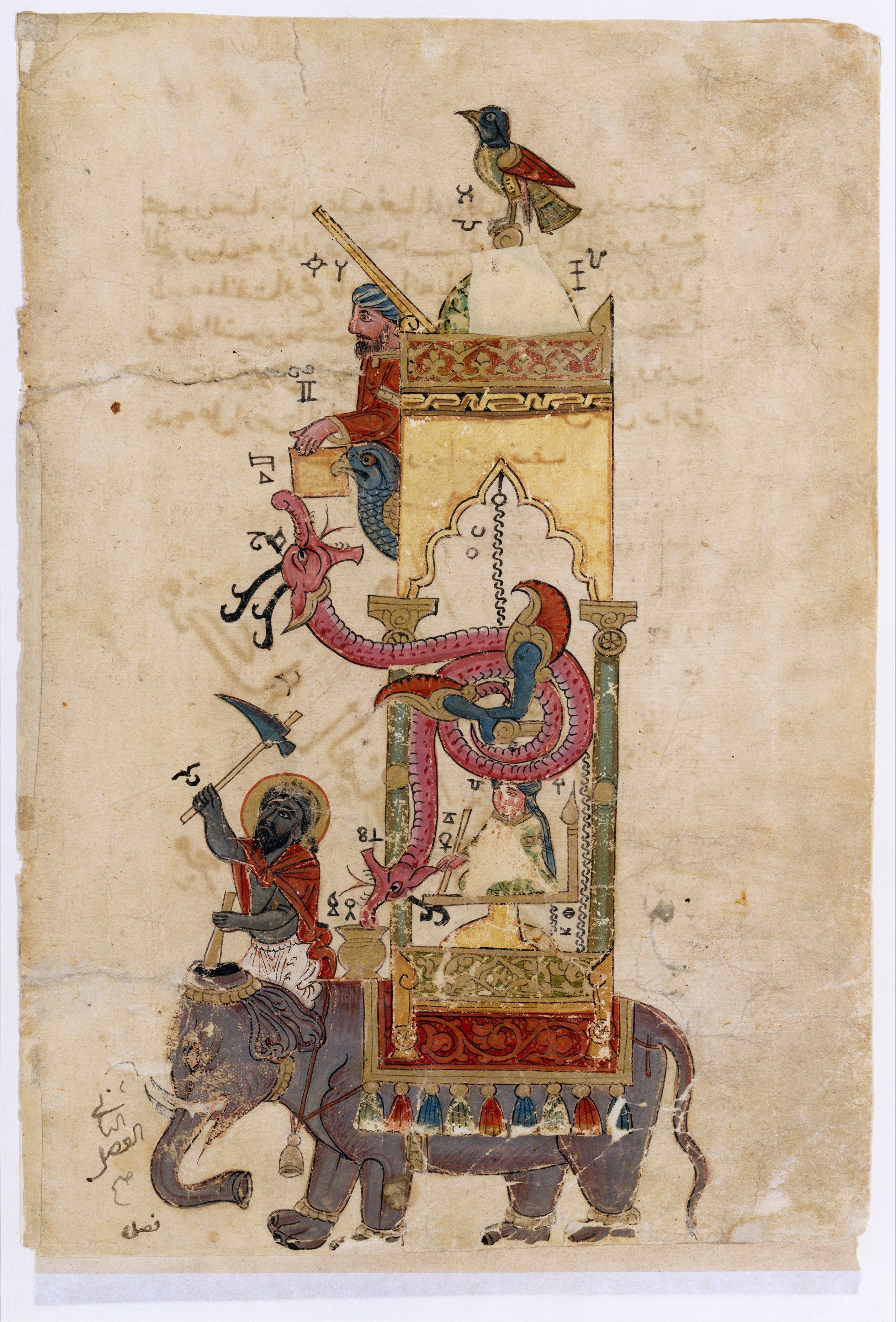
Consider University of Manchester professor emeritus Salim Al-Hassani, the maintainer of the 1001 Inventions project and MuslimHeritage.com website. In an article dated 2004—well before the Jagged_85 editing spree began—he described the inner workings of the elephant clock, flow regulation, closed-loop operation, etc., but nowhere did he say these were the first appearances of the concepts. In 2007, Jagged_85 edited Wikipedia to claim that Muslims invented these things with the elephant clock, citing al-Hassani. Not long after, in 2008, al-Hassani published another article that made the same sorts of claims, with similar wording! These errors were then reprinted widely, including by businesses that still have the claims up today.
How Do False Claims Make it to You?
False claims laundered from Wikipedia make it into academic circles and further into the zeitgeist, because they inform people about things they can say and should believe. They go further than that because they are believed, and because, in these cases, they are plausible—by virtue of academic acceptance, Wikipedia presence, scholarly bona fides, etc.—and people want to believe them; it is fashionable to talk about an exaggerated Muslim Golden Age and era of invention. Muslims are newly being introduced into Western societies, so just as Christopher Columbus began to be celebrated to welcome Italians into America, we now find it worthwhile to talk about how Western scholars and historical geniuses were actually inspired by Muslims in ages long past, forgotten, and perhaps even intentionally obscured.
The most widely circulated false ideas achieve their prominence through becoming educational: they are now the sorts of facts people should know, not just academic obscurities. For example, Salim al-Hassani set up an exhibit at London’s Science Museum, and London journalist Olivia Sterns saw the exhibit and decided to write about it for CNN. The article included the false claim ultimately sourced from Jagged_85, that the crank was invented by Al-Jazari in the 12th century.
In a similarly poor and viral showing, Sean Carroll evidently used Wikipedia to try to figure out who had coined momentum, and in doing so, he quoted an error that originated with edits made by Jagged_85. He attributed the thing to Avicenna, using wording derived from Jagged_85. Avicenna, as it turns out, was miscited, and this wasn’t the first time. People might also have been exposed to Jagged_85 edits about Avicenna by way of Google Books descriptions, listings on sites like Booktopia and Goodreads, and so on, which have all featured improper descriptions of translations of Avicenna’s Canon of Medicine, claiming that the author—Avicenna—invented randomized controlled trials and risk-factor analysis.
What the Jagged_85 saga shows us is that with a little gumption, anyone can flood our shared information environment with garbage. They can have lies and exaggerations cited by thousands of scholars, educational programs and pamphlets, museum exhibits, journalists, and search engines alike, because no one checks, and people get lazy.
Who knows how many Jagged_85 edits have survived in the public consciousness, making people feel wrongly ‘informed’ about Islam and the Muslim world? Knowing just a few dozen of them, I can personally attest that I see them multiple times a year. I’m also occasionally privy to other famous Wikipedia-derived false claims like those about the electric toaster inventor Alan MacMasters—who never existed despite making it onto multiple BBC programs—, the ones about the nonexistent gas chambers in Warsaw (the real gas chambers were elsewhere), or the various articles on Chinese deportations and nonexistent silver mines in Russian history invented by the editor Zhemao. Who knows how much literature, how many TV programs, how many ‘fun facts’ are nothing more than the invention of some unsavory Wikipedian?
This was a timed post. The way these work is that if it takes me more than an hour to complete the post, an applet that I made deletes everything I’ve written so far and I abandon the post. You can find my previous timed post here.
A message from my sponsor, Mechanize:
We’re hiring software engineers to build environments and evals that frontier AI labs use to train coding agents.
To get a better sense of the work we do, you can check out GBA Eval, where we had models build Game Boy Advance emulators from scratch and scored their performance.
Base pay starts at $300K/year for junior software engineers, with more for senior roles, plus equity and performance bonuses. Apply here.
With the advent of LLMs, this problem has been compounded. LLMs will cite Wikipedia-based confabulations as if they’re accurate representations of their sources. To ensure you don’t get misled, you need to actually know something is off about what the LLM tells you. I’ve written about how I believe that this is the core issue with using LLMs for research.
It's for this reason that I want to investigate the actual substance of the Islamic Golden Age. Too often, there's a tendency to credit the Arabs with some important discoveries, when in fact it wasn't so.
Most prominent example is the Arabic numerals that were actually invented in India.
You crazy for this one Cremieux
Do we have no idea who jagged_85 is?